What is a restricted water supply?
Unlike most urban water supplies, where water is available on demand directly from the network whenever you turn on a tap, restricted water supplies deliver a set volume of water to your property each day.
Restricted supplies are used on some rural, rural-residential and urban fringe water schemes where available water resources and infrastructure capacity need to be carefully managed. They are also commonly used to service properties on larger land sizes, where water demand is typically higher and metered, on-demand use could place significant pressure on the network and reduce the reliability of supply for other connected properties.
Water is delivered continuously by trickle feed throughout the day through a flow restrictor, which controls the rate at which water enters your private storage tank.
Why some properties have a restricted supply while others nearby have a water meter
The type of water connection provided to a property depends on several factors, including:
- The water scheme it is connected to
- Available infrastructure capacity, for example the size of the network pipes, pressure and distance to the treatment plant
- Property size
- Anticipated demand
- The standards and requirements that applied when the property was developed
In some areas, there is a mix of metered and restricted connections, often reflecting differences in land size and demand. In rural, rural-residential and urban fringe areas, restricted supplies are commonly used to help manage available water resources and ensure a reliable supply can be shared fairly among connected properties.
How restricted supply works
If you live in a restricted water scheme area, and are connected to the Selwyn Water network, you must have:
- A suitable water tank storage
- A pump to move water from your tank into the home
- Enough water tank storage to meet the minimum requirement for your area (shown in LIMs and PIMs)
We recommend installing a water tank large enough to hold at least three days of water. More storage improves resilience during maintenance or outages and helps your system recover more quickly.
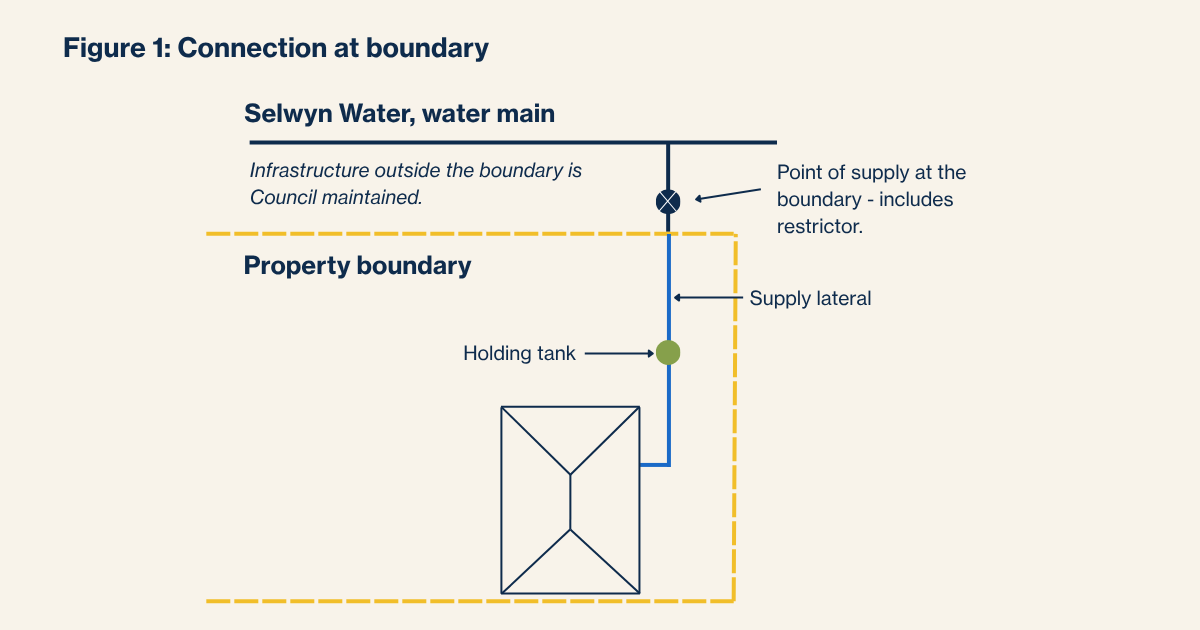
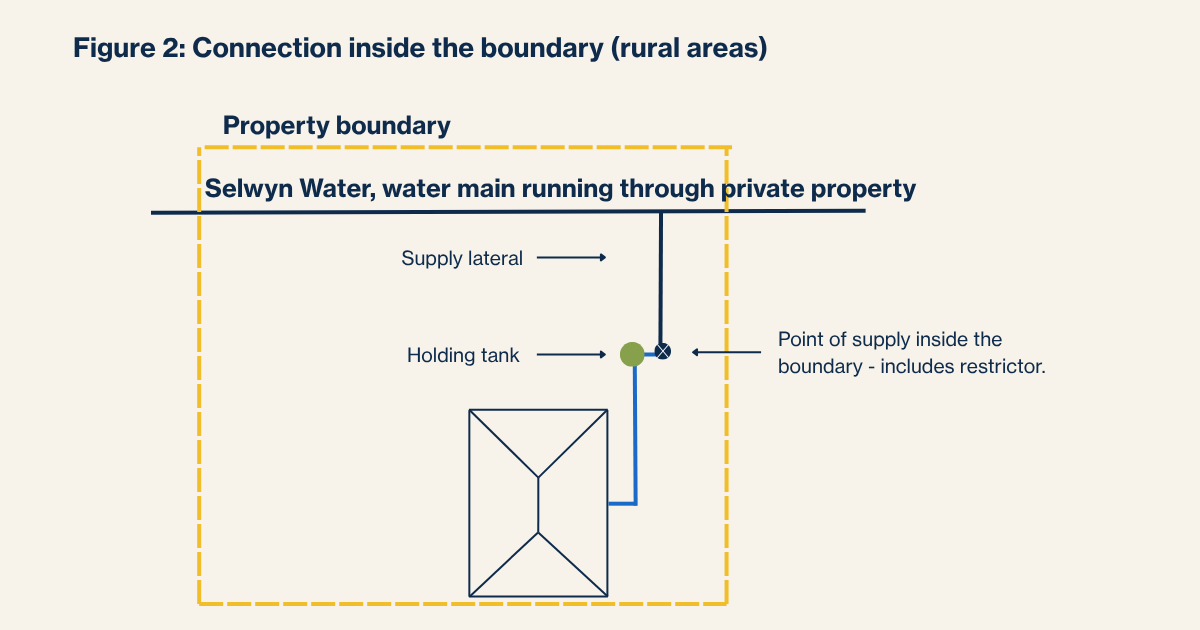
Restricted supplies include a restrictor which is installed and maintained by Selwyn Water. Pipes and fittings on Selwyn Water’s side are shown in blue in standard diagrams; pipes on the customer side are shown in bright blue and must be installed and maintained by the property owner.
Water is allocated in units
One water unit provides 1,000 litres of water over a 24-hour period.
The number of units allocated to your property determines how much water is delivered each day.
How water units are allocated
Water connection requirements, including the type of connection and, where applicable, the number of water units allocated to a property, are typically determined during the planning and consenting process.
Allocations are based on a range of factors, including:
- Property size
- Intended land use
- Anticipated water demand
- Available scheme capacity
- Engineering requirements at the time of development
If you're unsure why your property has a particular allocation, your Resource Consent, Land Information Memorandum (LIM) report or other property records may provide information about the servicing requirements that applied when the property was developed.
Your water allocation represents a share of the scheme
For properties on a restricted water supply, allocated water units represent a share of the scheme's available capacity that has been reserved for that property.
Even if you don't use your full daily allocation, the infrastructure and network capacity needed to provide that level of service must still be available and maintained. This is why restricted water charges are based on allocated water units rather than the amount of water used on any given day.
Fully restricted schemes
Some Selwyn water schemes, including Hororātā, Dalethorpe and Acheron, are fully restricted and fully allocated, meaning all available capacity within the scheme has already been assigned to connected properties.
These schemes are supplied by surface water sources, where water availability can be more vulnerable to seasonal and environmental conditions. In these schemes, water allocations help ensure available supply can be shared fairly and reliably while supporting the long-term sustainability of the water source.
In fully allocated schemes, if you choose to reduce your allocation, it may not be possible to increase it again later. Any surrendered water units may be reallocated by Selwyn Water to other properties waiting for capacity.
Your responsibilities
Once the water passes the point of supply, responsibility shifts to the property owner. You are responsible for:
- Monitoring the water level in your tank
- Ensuring your tank is large enough to avoid running out if you exceed your daily allowance
- Paying for a private tanker refill if your tank runs dry and you need urgent water
- Keeping the area around your equipment clear and accessible
- Not allowing others to take water from your point of supply without approval
- Not tampering with or removing the restrictor (this is an offence under the Selwyn District Council’s Water Supply Bylaw and may result in repair costs or prosecution)
- Checking for underground pipes before digging or planting. If you damage Selwyn Water-owned pipes during excavation, you will be liable for repair costs.
Annual tank maintenance
All customers on a restricted water supply must clean and disinfect their water storage tanks at least once a year.
Guidance on how to clean and disinfect your tank is available on Health Ed and PHF Science.
Our responsibilities
Selwyn Water is responsible for:
- Supplying, installing and maintaining the restrictor
- Maintaining the lateral pipe from the water main to the restrictor
- Approving and inspecting any new laterals built at the owner’s cost
- Testing your restrictor if you believe it is not delivering the correct amount of water
To request a restrictor inspection, please contact us. If the restrictor is found to be faulty, you will not be charged for the inspection.
Applying for a change to your water units
If you need to request an increase or decrease in your water units, please submit an online application form.
While we will assess your request, approval cannot be guaranteed. Any alteration that can be supported will be permanent. A request to increase water units can only be made up to the maximum allocation allowed for the water supply scheme you are connected to. In most cases, a water‑modelling assessment may be required to confirm available capacity within the scheme.
Thinking about reducing your restricted water allocation?
Before you apply to reduce your allocation carefully consider your year-round water requirements. While a lower allocation may reduce your costs, it will also reduce the amount of water available to your property each day. During periods of high demand, such as summer, a lower daily allocation may not provide enough water to meet your needs, increasing the risk of your storage tank running low or running dry.
Things to consider before reducing your allocation
If you reduce your allocation, the rate at which water is supplied to your property will also be reduced. This means:
- Your property's restricted flow rate will be reduced through a new restrictor unit.
- Water storage tanks will take longer to refill, particularly during periods of high demand.
- You are responsible for ensuring the reduced allocation remains suitable for your current and future water requirements.
While your current water use may be low, it's important to think about your future needs, including:
- Summer water demand
- Household size and future family requirements
- Outdoor water use and irrigation needs
- Livestock or lifestyle block requirements
- The needs of future property owners
A reduced allocation may meet your needs today but may not be sufficient in the future.
Example: Reduction from 3 water units (3,000 litres per day) to 1 water unit (1,000 litres per day).
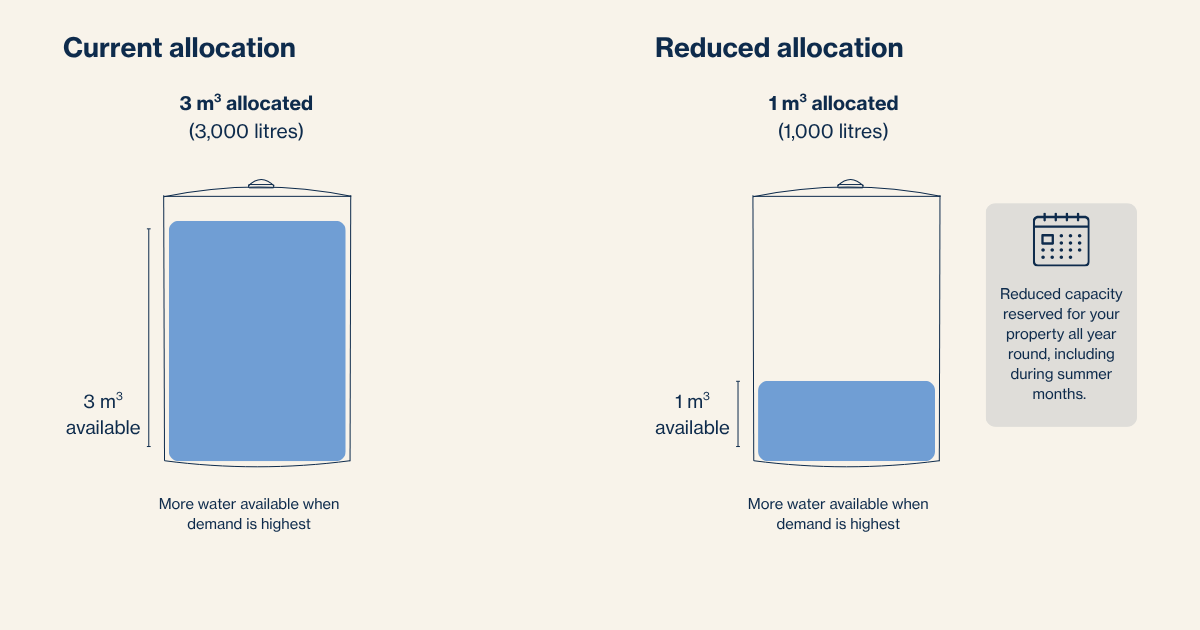
1 water unit a day is the equivalent of around 10 showers.
Important: reducing your allocation is a long-term decision
A reduction in water allocation should be considered a permanent change that will impact future property owners.
Once water units have been surrendered, it may not be possible to have them reinstated later particularly in fully allocated schemes, or those nearing capacity. They may be reallocated to others and any future request to increase an allocation would need to be assessed against the available capacity within the scheme at the time and cannot be guaranteed.
The reduced allocation remains with the property and will form part of the property's records unless a future application for additional units is approved.
For this reason, Selwyn Water recommends retaining at least two water units for a domestic household of four people. Properties with larger sections, irrigation requirements or additional water demands may require a greater allocation.
We’re listening to customer feedback
At this stage, Selwyn Water has continued the charging arrangements historically applied by the Council for restricted water supplies, including the charges associated with changing water unit allocations. We have not introduced a new charging methodology and currently administer these schemes on the same basis as they have been managed in the past.
At the same time, we understand some customers would prefer charging arrangements that more closely reflect actual water use. We are reviewing how restricted water supplies operate and exploring potential future options that balance:
- Customer expectations
- Water conservation
- Service reliability
- Long-term scheme sustainability
Any changes would be subject to consultation with the community.